Off-Grid Power Systems for Business: Keep Running When the Grid Can’t
In late October, Storms Austen and Boelo left 838,700 properties across Britain without power at some point, according to the Energy Networks Association. One Cumbrian manufacturer expected to lose two days of production and distribution in the run-up to Christmas, its busiest time of year. The same report notes that standard business interruption cover usually needs physical damage at your own premises, so a power cut caused by damage elsewhere on the network may not be covered unless you have a specific utilities extension.
For a growing number of UK businesses, the answer is to stop relying on the grid alone. Off-grid power systems built around battery storage let a site generate, store and manage its own electricity, either as a full-time setup or as a way to keep running when the grid goes down. This guide explains how they work, who they suit and what to look for.
What does “off-grid” mean for a business?
For a business, off-grid power usually means one of two things:
- Fully off-grid. The site has no grid connection, or doesn’t use one, and runs entirely on its own generation and storage. This suits remote locations where a grid connection is unavailable, too slow or too costly to bring in.
- Grid-connected with off-grid capability. The site normally uses the grid but can disconnect and run independently (known as “island mode”) whenever the grid fails or is unreliable.
Most commercial sites fall into the second group. They want the convenience of a grid connection with the security of knowing they can keep going without it.
How an off-grid power system works
At the heart of any off-grid power system is a battery energy storage system (BESS). It stores energy from whatever sources the site has and supplies it to the loads that need it.
A well-designed system brings together:
- Energy inputs. These can be the grid, solar PV, a generator, wind, or a combination of them.
- An off-grid battery. Lithium iron phosphate (LFP) batteries are widely used for commercial sites because of their stability and long service life.
- A grid-forming inverter. This is what makes off-grid operation possible. When the grid isn’t there, the inverter creates its own stable voltage and frequency, so equipment runs as normal.
- An energy management system (EMS). This decides when to charge, when to discharge and which source to draw from, automatically.
When the grid fails at a grid-connected site, a static transfer switch moves essential loads onto battery power. On a Teconnex Power system this happens in 15 milliseconds, so most equipment keeps running without interruption.
Battery and generator: the hybrid approach
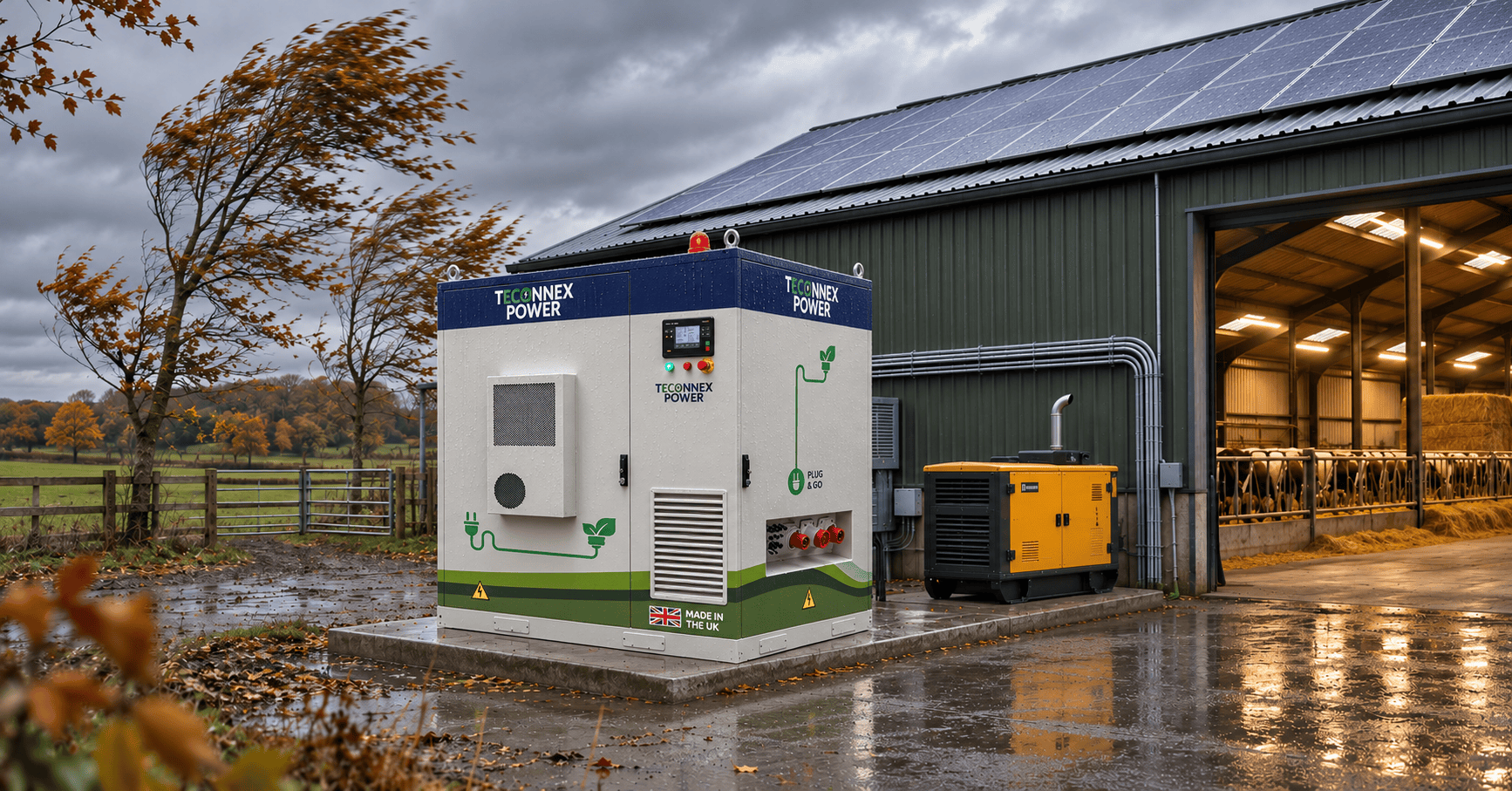
Many businesses already rely on a diesel generator for backup. On its own, a generator has limits. It takes time to start, it isn’t efficient when lightly loaded and it needs fuel and regular maintenance.
Pairing a generator with battery storage, often called a generator hybrid system, plays to the strengths of both:
- The battery responds instantly when power is needed, covering the gap while the generator starts.
- The battery supplies smaller loads on its own, so the generator doesn’t have to run for long periods at low output.
- When the battery needs charging, the generator can run at a steadier, more efficient load and then switch off again.
The result is a quieter, more flexible off-grid power supply that can mean fewer generator running hours. How many fewer depends on your loads and how the system is set up, which is why a site assessment matters.
Adding solar and wind
Renewable generation makes an off-grid power system far more self-sufficient. An off-grid solar system captures energy on site during the day, and the battery stores what isn’t used straight away so it’s available later. Wind can add generation at different times, including overnight and in winter.
With solar or wind in the mix, the generator becomes a fallback rather than the main source of power. That can be a significant step towards your sustainability goals as well as your resilience plans.
Which businesses benefit most?
Off-grid power and off-grid battery storage suit any site where losing power is costly or where the grid can’t be relied on. Common examples, across the sectors we work with, include:
- Farms and agricultural businesses. Irrigation, grain drying, refrigeration, workshops and livestock buildings can’t wait for a network repair. Rural sites are often at the end of long overhead lines that are vulnerable to storm damage.
- Remote and rural sites. Where a new or upgraded connection is unavailable or would take a long time, off-grid power lets the business operate now.
- Manufacturing and process sites. A sudden outage can scrap work in progress, damage equipment and stop deliveries.
- Cold storage, retail and food businesses. Refrigeration keeps working, protecting temperature-sensitive stock.
- Data centres and critical facilities. Battery storage can work alongside existing generators or combined heat and power (CHP) to protect essential systems.
- Events and leisure venues. Stored energy is ready when you need it, for match days, concerts and peak visitor periods.
What to look for in an off-grid power system
Not every battery system is designed to run a site independently. When you compare off-grid power systems, check for:
- True off-grid (island) capability. The inverter must be able to form its own grid, not just follow an existing one.
- Fast automatic switching. For grid-connected sites, look for a tested transfer time. Teconnex Power systems switch in 15 milliseconds.
- Multiple energy inputs. The system should accept grid, solar, generator and wind inputs and manage them together.
- Scalable capacity. Your needs will change. Teconnex Power ESS covers 25kWh to 1MWh, from compact cabinets to containerised systems, and is modular so you can add capacity later.
- Built-in safety. Every Teconnex Power ESS has heat, smoke and gas detection, with fire suppression fitted as standard.
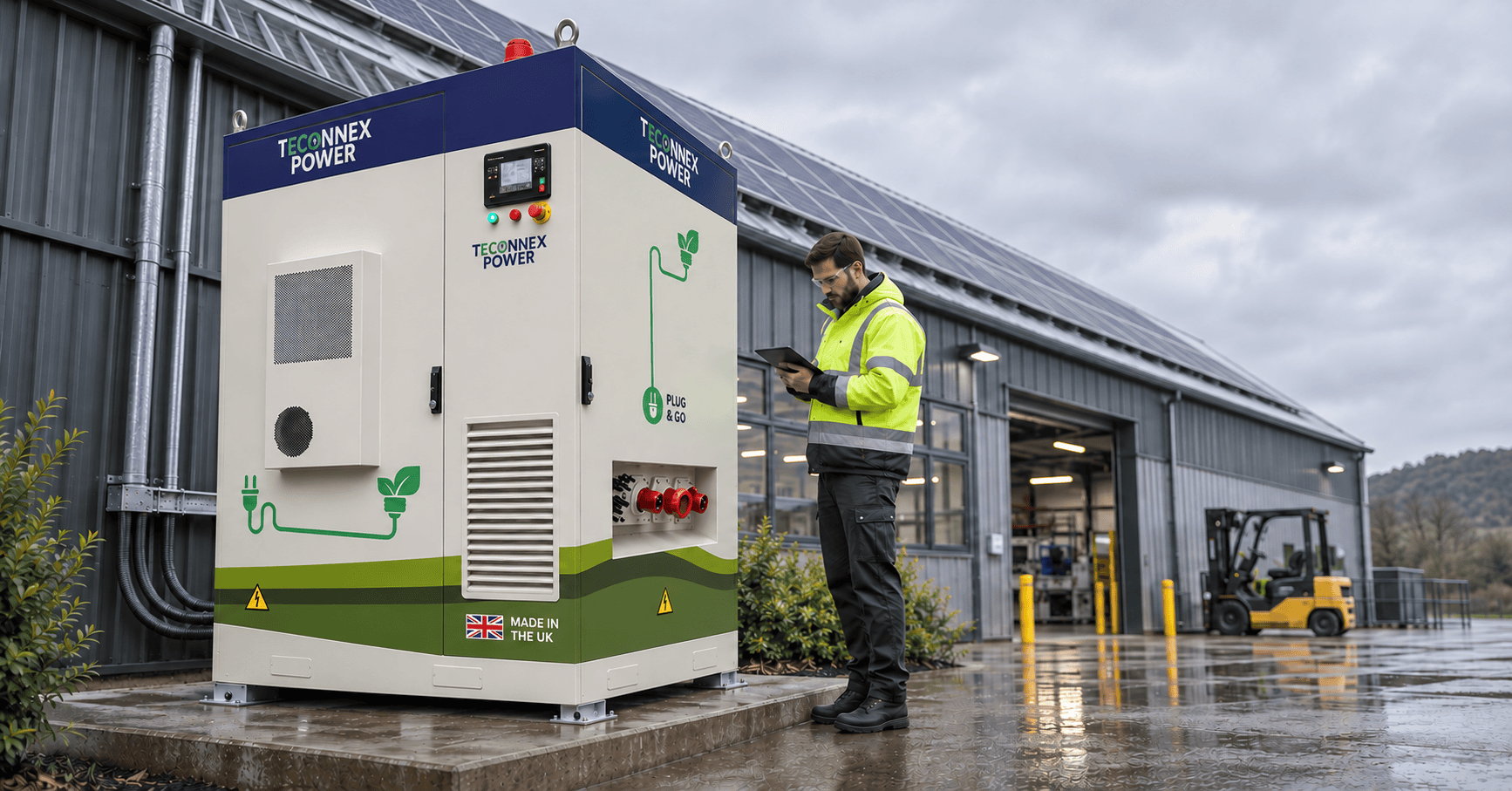
- IP55-rated, climate-controlled outdoor cabinets. These protect the batteries in UK weather and keep them at the right temperature.
- Remote monitoring. Teconnex Power systems use ComAp monitoring, a platform widely used across the power generation industry, giving you live data, alarms and remote access so you can see what your off-grid power supply is doing from anywhere.
How big does an off-grid battery need to be?
Sizing depends on three things:
- Which loads you need to run. Is it the whole site, or just critical equipment such as refrigeration, IT, security and lighting?
- How long you need to run them. A few hours of cover during an outage is very different from running a site full time.
- What generation you have. Solar, wind and generators all recharge the battery, which reduces the storage you need.
Seasonal patterns matter too, particularly for farms, where grain drying or irrigation can create sharp jumps in demand at certain times of year. A site survey and a look at your energy data are the best way to get the size right.
Off-grid power, built in the UK
Teconnex Power energy storage systems are designed and manufactured in the UK, can run fully off-grid, and accept power from any source: grid, solar, generator or wind. Each system is factory tested before delivery, and our UK team supports you from consultation and site survey through to installation, commissioning, remote monitoring and maintenance. Batteries and inverters carry a five-year warranty, with one year on all other components.
Frequently asked questions
What is an off-grid power system?
An off-grid power system lets a site generate, store and use its own electricity without relying on the national grid. It typically combines battery storage, an inverter that can form its own grid and an energy management system, with energy coming from solar, wind, generators or a grid connection when available.
Can a business run completely off-grid?
Yes, with the right combination of generation and storage. Fully off-grid sites usually pair battery storage with solar and a generator as backup. Many businesses instead stay grid-connected but install a system that can run independently whenever the grid fails, which gives the best of both.
How long can an off-grid battery power my site?
It depends on the battery’s capacity, the loads you run and whether solar, wind or a generator is recharging it. A system sized for critical loads may run for many hours or longer, while one supporting a whole site will need more capacity. A site survey will establish the right size.
Do I still need a generator with battery storage?
Not always, but many businesses keep one. A generator hybrid system uses the battery for instant response and smaller loads, and runs the generator only when the battery needs recharging or demand is high. This approach can reduce generator running hours while giving extra security during long outages.
Talk to the Teconnex Power team
If the recent storms have put power resilience on your agenda, we can help. Our UK team will look at your site, your critical loads and your energy sources, and recommend an off-grid power system that fits.
Email sales@teconnex.com or send us an enquiry to arrange a conversation with the Teconnex Power team.
Sources
- Insurance Business – Storm Boelo clean-up puts business interruption in focus (27 October 2026)
Talk to our UK team
More news and guides